


Suspended Floor Insulation in Ireland: Results, Costs and Benefits

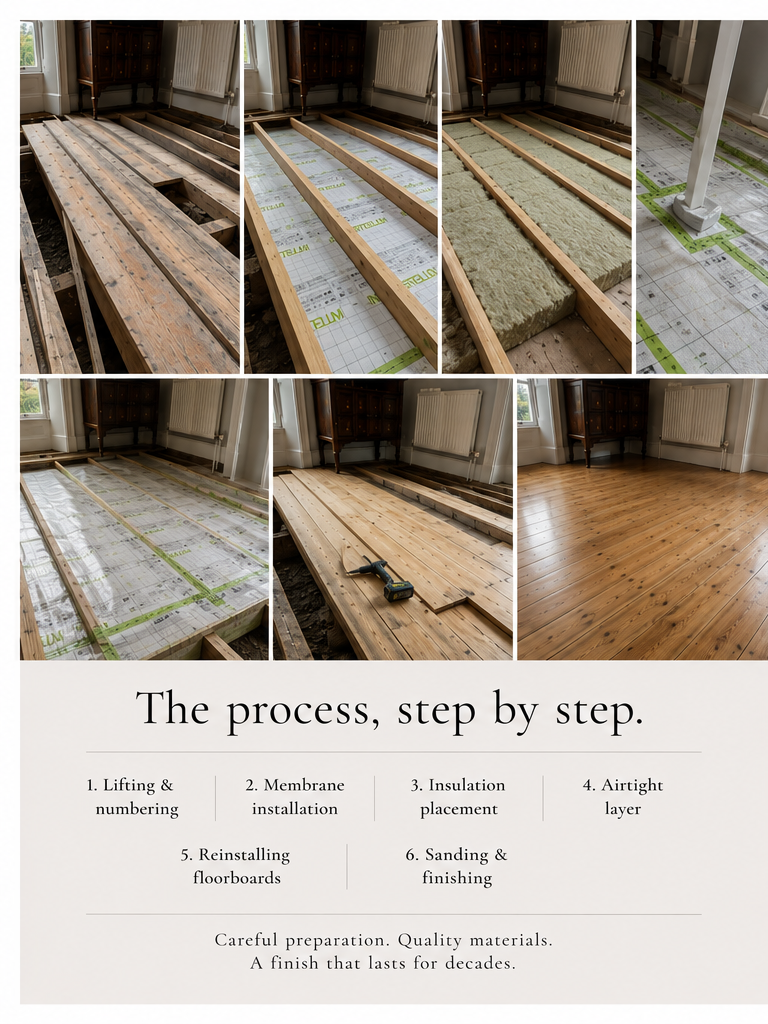
In our previous article, we followed the suspended floor insulation process from lifting and numbering the original floorboards through to the membrane, insulation, airtight layer and finally the reinstatement and restoration of the timber floor.
At the old stone house that has followed us through this series, the difference between the beginning and the end of the work was not about changing the character of the property. Outside, the same two Adirondack chairs still looked across the quiet countryside. Inside, the original boards were back where they belonged, with the work beneath them almost completely hidden from view.
That is one of the interesting things about suspended timber floor insulation. When it is completed properly, most of the work disappears.
What remains is the original floor and, more importantly, a room with the potential to perform very differently.
A Warmer Floor Changes How the Whole Room Feels
One of the most immediate floor insulation benefits is improved comfort.
In an uninsulated suspended timber floor, cold air circulates through the void beneath the boards. This ventilation is necessary for the timber structure, but without insulation separating that space from the room above, the floor can remain noticeably cold.
Once the floor is insulated correctly, less heat is able to escape into the ventilated void beneath it.
The purpose is not to make the timber itself feel artificially warm. It is to reduce the constant cooling effect from below and help the room retain more of the heat already being produced inside the house.
In older properties across Ireland, where cold floors can influence the comfort of an entire room, that difference can be particularly noticeable.
Reducing Draughts Through the Floor
Cold floors and draughts are closely connected.
Older floorboards naturally develop gaps over time. Air can also enter around the perimeter of the room or through openings around services.
Insulation alone is only part of the solution.
The airtight layer installed as part of the suspended floor insulation process helps reduce uncontrolled air movement between the room and the ventilated void underneath.
This can change the way a room feels even before energy use is considered. A space with fewer cold draughts is simply more comfortable to live in.
Reducing draughts inside the room does not mean blocking the ventilation beneath the floor. The two areas need to remain separated so the living space is protected from cold air movement while the timber structure below continues to receive the ventilation it needs.
Improving Energy Efficiency
Every part of a building contributes to how well it retains heat.
For older houses with uninsulated suspended timber floors, the floor can be one of the areas where heat leaves the living space.
Adding an appropriate insulation system reduces this heat transfer and improves the thermal performance of the floor. This means the heating system does not have to replace lost heat as quickly as it would in an uninsulated room.
Actual energy savings from floor insulation will always depend on the individual property. The size of the house, existing wall and roof insulation, windows, heating system, airtightness and the way the occupants use the building all influence the final result.
For that reason, it would be misleading to promise a particular percentage saving from the floor alone.
What suspended floor insulation can do is address one important source of unnecessary heat loss from an older property.
Can Floor Insulation Reduce Heating Bills?
Improved thermal performance can contribute to lower heating demand.
If a room retains heat for longer, less energy may be required to maintain a comfortable temperature. How much this translates into reduced heating bills depends on the house and on how the heating is used.
For some homeowners, the biggest difference may not initially be a figure on an energy bill. It may be that a previously uncomfortable room becomes easier to heat and remains comfortable for longer after the heating has been turned down.
Energy efficiency and comfort are closely connected, but neither should be reduced to a single promised number. Properly installed suspended timber floor insulation is one part of improving the overall performance of the building.
What About Noise?
Thermal insulation between floor joists can sometimes bring another benefit that is discussed less frequently.
Insulation material can help absorb some sound travelling through the floor structure.
The extent of any noise reduction depends on the construction of the property, the insulation system and the source of the sound. Suspended floor insulation should not be treated as a replacement for specialist acoustic insulation.
However, in some homes, homeowners may notice that the floor feels slightly less hollow or that certain sounds travelling through the structure are reduced.
This is a secondary benefit rather than the main reason for carrying out the work, but it can contribute to the overall feeling of a more comfortable room.
Does Suspended Floor Insulation Add Property Value?
It is difficult to place a specific financial value on one improvement in isolation.
A buyer is unlikely to value a property simply because insulation has been installed beneath one particular floor. What can matter is the overall condition, comfort and performance of the house.
An older property that retains its original timber features while also addressing comfort, draughts and heat loss can be more appealing than one where those issues have been ignored.
For period properties in particular, there is also value in improving performance without unnecessarily removing original materials.
Preserving a good original timber floor while improving what is happening beneath it can offer a thoughtful balance between character and modern comfort.
How Much Does Suspended Floor Insulation Cost in Ireland?
There is no meaningful single price that applies to every suspended timber floor.
The suspended floor insulation cost in Ireland depends on several factors, including the size of the floor, accessibility, the condition of the existing boards and joists, the insulation system required and whether additional restoration work is being completed at the same time.
A straightforward floor with easy access will be very different from an original period floor where boards need to be carefully lifted, numbered, reinstated, sanded and refinished.
The timber floor assessment and inspection stage discussed earlier in this series is therefore important for pricing as well as for the technical work.
Until the existing floor and the full scope of the project are understood, a price based only on square metres may not tell the full story.
How Long Does the Work Take?
Project timelines vary for many of the same reasons.
The size of the area, the number of rooms, the condition of the existing floorboards, access beneath the floor and any additional work discovered during the inspection can all affect how long the project takes.
A floor that is being insulated only will also have a different programme from one where the original timber is being lifted, reinstated, sanded and refinished as part of the same project.
Careful work with an older floor takes time.
The aim is not simply to open the floor and close it again as quickly as possible. It is to complete the work beneath it while protecting the boards that need to return on top.
A proper inspection before work begins makes it much easier to establish a realistic timeline for the individual property.
Keeping the Character While Improving Comfort
Throughout this series, we have returned to the same principle.
Improving an older timber floor does not have to mean removing what made it special in the first place.
We began by looking at why suspended floors can feel so cold. We then went beneath the boards to inspect the joists, moisture, ventilation, woodworm and air bricks. In the third article, we followed the installation process from carefully lifting the floor through to reinstating, sanding and finishing the original timber.
The final result brings those stages together.
The floor can remain part of the history and appearance of the house while the structure beneath it is adapted to meet very different expectations of comfort and energy efficiency.
For us, that is the point of this kind of work.
The goal is not to turn an old house into a new one. It is to help the original building work better for the people living in it today.
For professional suspended timber floor insulation, timber floor assessment and floor restoration across Ireland, visit www.dadaflooring.ie or contact Dada Flooring to discuss your property.
Dada Flooring
085 158 3937


Comments