


Why Are Suspended Timber Floors So Cold in Ireland’s Older Stone Houses?
Updated: Aug 29

One of the unique projects we completed recently was the restoration of a beautiful old stone house set in one of Ireland’s scenic rural locations. Surrounded by countryside, the property was full of history, character and the kind of details that simply cannot be
recreated in a modern build.
Stone houses have a personality of their own, and their original timber floors are often one of their most striking features. Years of use leave subtle imperfections in the boards, while the natural patina of the timber becomes part of the history of the house.
Restoring the Character, Not Erasing It
One of the biggest challenges with this project was respecting the age and history of the property while creating a floor that would remain practical, durable and beautiful for years to come.
In a property like this, floor restoration is about much more than improving appearance. Older homes are rarely perfectly level and every board has its own character. Every stage of the sanding and restoration process therefore had to be approached carefully.
Our goal was never to make the floor look brand new.
Instead, we wanted to restore it properly while allowing the natural character, imperfections and history of the timber to remain part of the home.
What We Found in the Previous Finish
During the restoration, we discovered another issue that can be found in older timber floors.
The floor had not been prepared or finished correctly during a previous renovation. Poor sanding techniques had left visible sanding marks and an uneven surface. This had also affected how well the previous finish bonded with the timber.
Simply applying another finish over the existing surface would not have solved the problem.
Correcting it required careful sanding and preparation to establish a properly prepared surface before the new finish could be applied. This stage is particularly important with older floors, where removing too much material can unnecessarily take away some of the character that you are trying to preserve.
But the condition of the surface was only part of what we discovered.
What Was Happening Beneath the Timber Floor
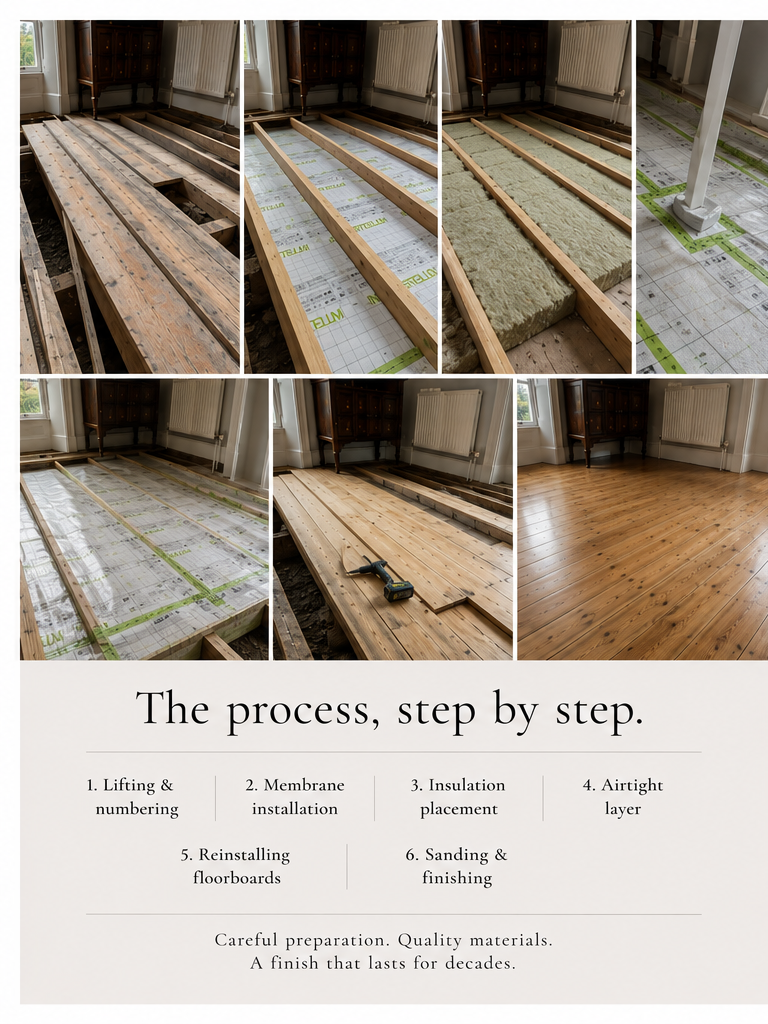
While lifting sections of the floor, we were able to see something that helps explain why many older Irish homes can feel particularly cold during winter.
Many older stone houses across Ireland were built with suspended timber floors.
Unlike a modern concrete floor, the floorboards are supported by timber joists with an open void beneath them. Air bricks built into the external walls allow outside air to circulate through this space.
That ventilation serves an important purpose.
Air movement beneath the timber helps control moisture and protects the floor structure against problems such as rot and fungal decay.
However, it can also contribute significantly to how cold the floor feels.
During colder weather, outside air continually passes beneath the floorboards and cools the timber from below. If there is no suitable insulation between the living space and the ventilated void, heat from inside the house can be lost through the floor.
Homeowners may notice cold floors underfoot, draughts around the edges of the room and spaces that remain difficult to make comfortable even when the heating is running.
Why Older Stone Houses Can Be Particularly Cold
This issue is especially relevant to older properties because these houses were constructed long before today's expectations around insulation and energy efficiency.
Solid stone walls, suspended timber floors and natural ventilation all form part of the way these buildings were originally designed to function.
That does not mean those original features should simply be covered, sealed or removed.
The important part is understanding how the building works before deciding what should be changed.
The ventilation beneath a suspended timber floor, for example, should not simply be blocked in an attempt to stop cold air. That airflow is helping to protect the timber structure from excess moisture.
Any improvement therefore needs to consider both thermal performance and the long term health of the floor.
Restoration That Goes Beyond the Surface
For this project, restoring the floor was not simply about sanding and refinishing the visible timber.
Opening sections of the floor gave us an opportunity to understand what was happening underneath it and consider how its performance could be improved without taking away the character that made the property special in the first place.
By combining careful restoration with an understanding of the existing floor structure, an original timber floor can remain an important feature of an older property while also contributing to a warmer and more comfortable living space.
That balance matters.
A floor should not lose its history simply because the home needs to perform better.
Sometimes a Cold Floor Is Telling You Something
Cold timber floors can be a symptom of a much bigger story hidden beneath the boards.
Before adding insulation or beginning a significant restoration, it is important to understand exactly how the floor has been constructed, how air is moving beneath it and whether there are any underlying issues that need attention.
That is why inspection comes first.
In our next article, we will take you beneath a suspended timber floor and explain what we look for during a professional floor inspection, the problems that can be hidden below the boards and why identifying them before work begins can prevent much more costly problems later.
For professional timber floor restoration and suspended timber floor insulation across Ireland, visit www.dadaflooring.ie or contact Dada Flooring to discuss your property.
Dada Flooring
085 158 3937


Comments